Natural-language coordination sits above deterministic EPA SWMM execution. Goals, environments, tools, skills, artifacts, QA, calibration, and audit stay visible at every stage—and a run folder is organised for whoever opens it next.
Why this project exists
Stormwater modelling is rarely one command. A typical SWMM project can involve GIS preprocessing, rainfall formatting, parameter assignment, network assembly, INP construction, model execution, QA checks, plots, calibration, uncertainty analysis, and reporting.
Agentic SWMM provides a middle path: natural-language orchestration with deterministic SWMM execution, explicit provenance, project memory, and verification-first modelling.
The goal is not to replace SWMM or the modeller, but to make SWMM-based modelling easier to reproduce, audit, remember, and trust.
What changed in v0.9.4
Each answer belongs to a specific run.
Sessions across five Canadian cities shaped the latest release. It adds analysis without observed flow, brings past failures into planning, and preserves the context behind follow-up questions.
Questions about completed work use its existing artifacts. A failed run stays the reference until the user changes it, and a provider error leaves the shell open. Approvals identify the area and dates; a new area needs its own approval.
upstream
Name a published city
fetch_swmm_from_canada now accepts a city name as well as user-supplied coordinates. The retrieved bundle preserves its model, study-area map, source identifiers, and upstream QA.
deliverable
Hydraulics with units and limits
Typed report sections cover flooding, surcharge, depth, and runoff. Word reports include the evidence boundary and any design-review verdict; peak flows use the units recorded by SWMM.
audit + memory
Keep the record, use the lesson
Re-audits retain earlier records. Parameter sweeps and climate batches keep separate outputs. Failure memory and relevant parameter records feed the next plan, with modelling lessons anchored to their location.
What makes it different
Six surfaces, one evidence contract
01
Fast, explicit onboarding
Use the one-line installers, PyPI package, or a pinned Docker image. Installer checks cover macOS, Linux, Windows x64, and Windows on ARM. For agent runtimes, install the portable skills with one command.
02
Agent-guided, solver-grounded
Agents plan and route work while EPA SWMM execution remains deterministic, inspectable, artifact-based, and runnable from the CLI.
03
19 portable skills
GIS, climate, building, network, running, plotting, design review, calibration, uncertainty, water quality, reporting, audit, memory, and orchestration stay modular, with 11 MCP servers behind them.
04
58 typed tools
MCP interfaces expose typed modelling actions while planners are constrained by routing rules, input requirements, QA gates, and stop conditions.
05
Verification-first provenance
Upstream, build, run, QA, plot, audit, review, and report stages emit traceable artifacts before outputs are presented as evidence—and a run is allowed to conclude that its own results are disqualifying.
06
Supervised memory and skill evolution
Failure memory and relevant parameter records reach the planner before new work. Raw audit notes remain the source record, and proposed skill changes require human review and benchmark verification.
Choose the analysis your evidence supports
v0.9.4 can explore uncertain inputs before observed flow is available. The question determines whether to propagate ranges together, vary parameters individually, or compare simulations with observations.
Your question
Analysis
What the result means
How much could the output change within these parameter ranges?
Joint parameter-range propagation
An ensemble and output spread conditional on the stated ranges. Observed flow is not required.
Which parameter has the largest effect around this baseline?
One-at-a-time sensitivity ranking
Each parameter varies while the others stay at baseline. The ranking describes local effects and does not measure parameter interactions.
Which parameters best reproduce measured flow?
Observation-based calibration and sensitivity tools
Requires a reference series. Fit and validation claims depend on those observations and the evaluation period.
The first two routes use propagate_parameter_ranges, with joint or one-at-a-time mode. Rainfall scaling uses the climate-scenario route. Each batch retains its inputs and outputs for inspection.
Parameter spread describes the assumptions you supplied. It does not establish calibration or predictive accuracy for an unobserved catchment.
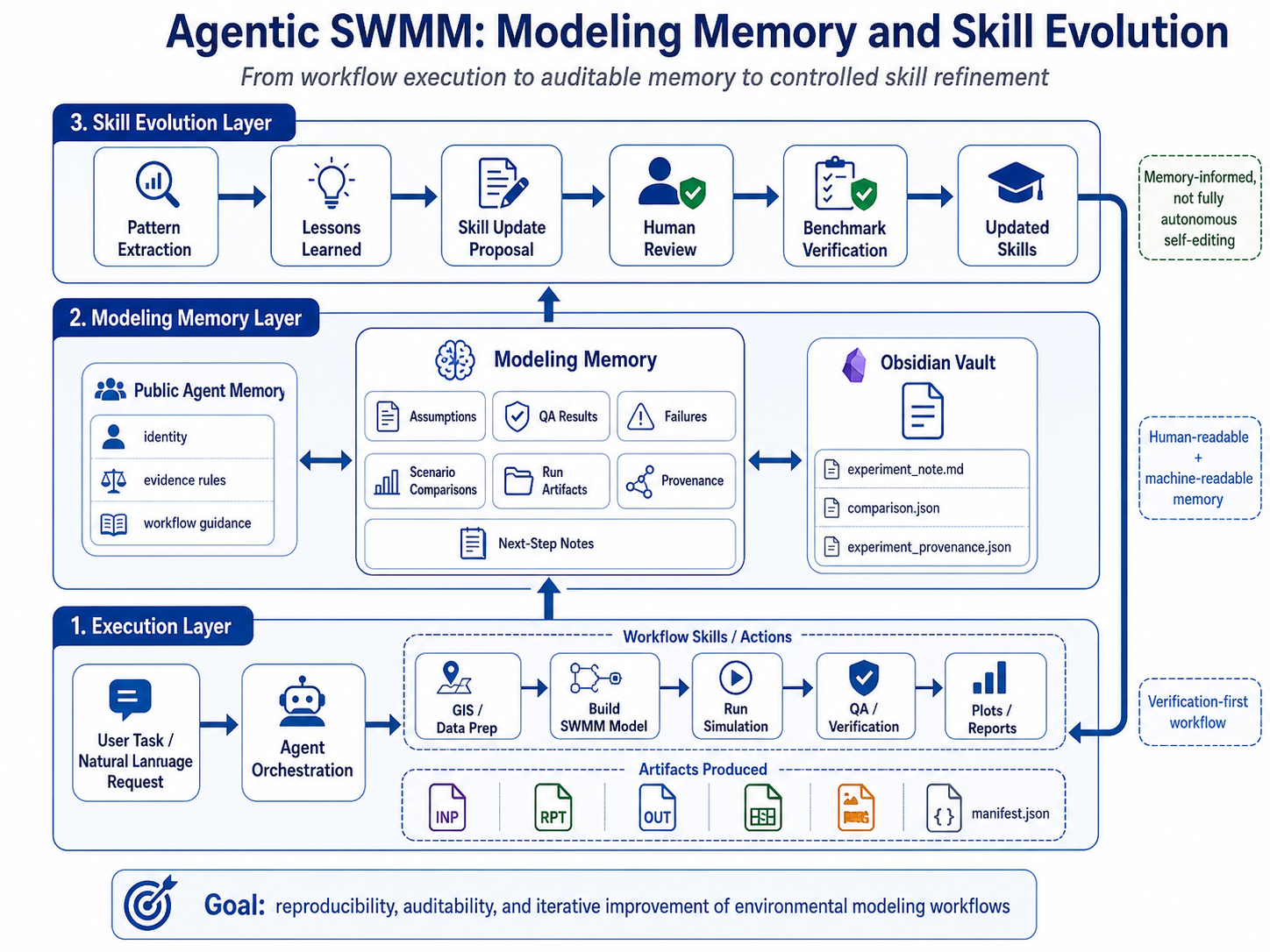
Execution, modeling memory, and controlled skill evolution — one auditable loop from request to verified result.
The workflow has three connected layers: execution, modeling memory, and controlled skill evolution. Natural-language requests can trigger reproducible SWMM actions; audited artifacts update human-readable and machine-readable memory; repeated patterns can produce skill-refinement proposals that still require human review and benchmark verification.
Bring the LLM you already pay for
Ten provider routes sit behind one detect-first aiswmm setup wizard: OpenAI, Anthropic, OpenRouter, DeepSeek, Groq, Gemini, local Ollama and LM Studio, OpenAI-compatible gateways, and custom endpoints. The wizard lists every route and detects what is already running on the machine.
Three of those routes need no API key at all, including a local gateway that fronts a ChatGPT plan — aiswmm gateway login installs a pinned build for the running OS and architecture, runs the browser OAuth, and leaves it serving. An optional local fallback chain keeps a session alive through outages and quota windows.
Never paste an API key into the aiswmm conversation. Configure it during setup or in your shell environment instead.
Two interfaces, one engine
A natural-language goal and a CLI verb pick from the same typed tools and write the same artifacts. Describe the work in a sentence when you want the chain planned for you; call aiswmm run, calibrate, climate, or audit directly when you already know the step. Neither path can reach a result the other could not reproduce.
rainfall-runoff figures, network maps, SCE-UA convergence and calibration summaries, best parameters, trials, and fuzzy uncertainty summaries
parameter-range ensembles and one-at-a-time sensitivity rankings without a required observed-flow series
figures styled to the project’s Nature specifications, with vector masters and raster previews
a per-scenario climate comparison of runoff, flooding, outflow, and peak flow under precipitation-scaled scenarios
audit records: experiment_provenance.json, comparison.json, and experiment_note.md
a design-review verdict against the chosen rulebook, and a Word report with figures, hydraulics, and explicit evidence limits; the report tool identifies when it uses the English template
a run README.md naming the deliverable, plus Obsidian-ready modelling notes and memory summaries