Follow-ups stay with their model
Questions return to the run they refer to. A failed fetch remains visible as a failed fetch, and provider errors leave the interactive session available to continue.
Describe the job in a sentence. Fetch a municipal storm network from SWMMCanada, run EPA SWMM, inspect uncertainty, and export an audited report with its inputs, checks, and limits in view.
Two days of natural-language sessions across five Canadian cities shaped this release: stronger run context, new analysis tools, and clearer evidence in every deliverable.
Read the changelog →Questions return to the run they refer to. A failed fetch remains visible as a failed fetch, and provider errors leave the interactive session available to continue.
Propagate stated parameter ranges or rank their effects one at a time. Each analysis retains its own files and reports flow in the model’s units, with its assumptions stated.
Failure memory loads at session start, relevant parameter records reach the planner, and new lessons stay anchored to the place being modelled.
Word reports state evidence boundaries and any design-review verdict. Re-audits retain the previous record, and expert decisions record an explicit yes or no.
This is not a chat wrapper around SWMM. The agent coordinates; the solver, checks, and artifacts remain inspectable.
Fetch a real municipal storm network through SWMMCanada, the upstream model-building project in the same ecosystem—or bring an existing .inp or prepared GIS layers.
EPA SWMM runs stay CLI-runnable. QA gates, SCE-UA calibration, precipitation-scaled climate scenarios, and direct solver comparisons keep automation grounded.
Provenance and experiment notes feed curated and raw memory. Skill changes remain proposals until a human reviews and benchmarks them.
The fifth city in the release campaign follows the same fetch, run, audit, and report chain. The model, figures, report, and session transcript are published together, so the SWMM simulation can be repeated offline.
Explore the Kelowna evidence →411 derived subcatchments, 889 storm nodes, 832 conduits, and 76 outfalls. The bundle also contains sanitary pipes; this simulation uses the storm system alone.
Principal-outfall peak 0.130 m³/s; system peak outflow 0.706 m³/s. Runoff continuity error −0.078%, routing −1.022%. The audit passed all three checks.
Ten conduits run uphill and five subcatchments route more than 50 m to their outlet. The model is an uncalibrated first pass with no observed flow supporting its predictions.
The published case includes the original model.inp, a sample Word report, upstream QA, report excerpts, and the full two-turn transcript.
SWMMCanada is the data-and-model-building layer of the same ecosystem: draw an area, and it assembles a ready-to-run model.inp from Canadian open data. Agentic SWMM consumes it through one typed tool and carries the retrieved archive and service identifiers into the run record.
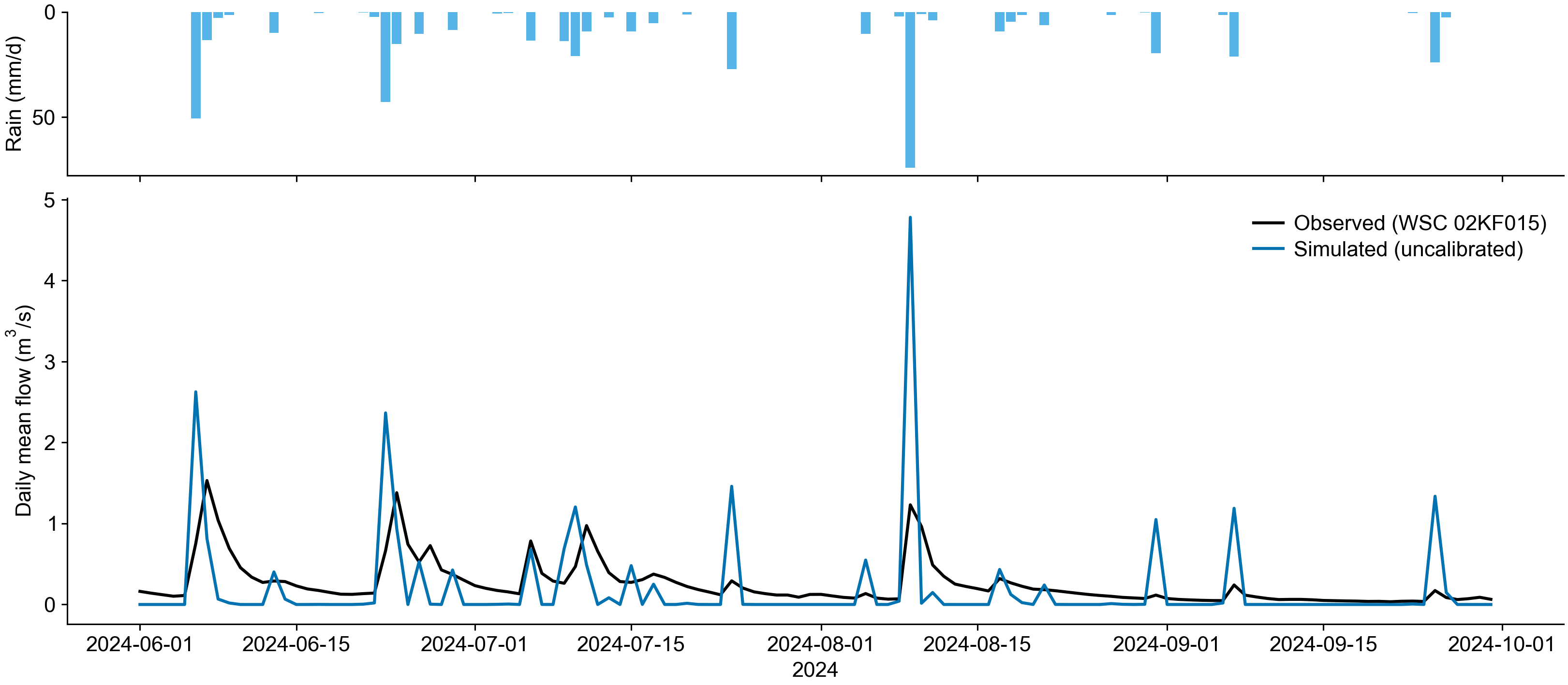
Benchmarks, research previews, and audit examples are presented with what they prove—and what they do not.
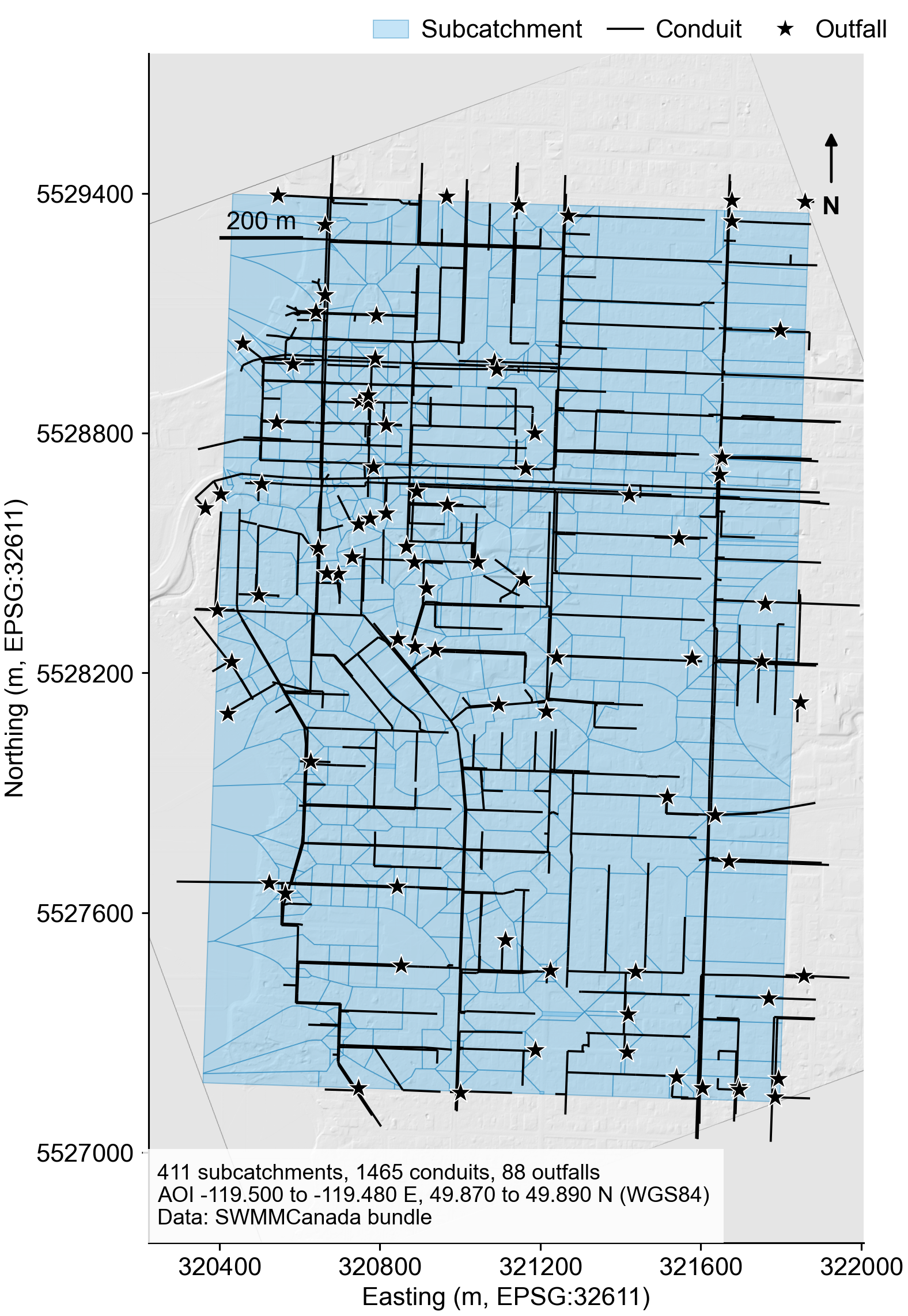
Map includes both networks; simulation uses storm pipes
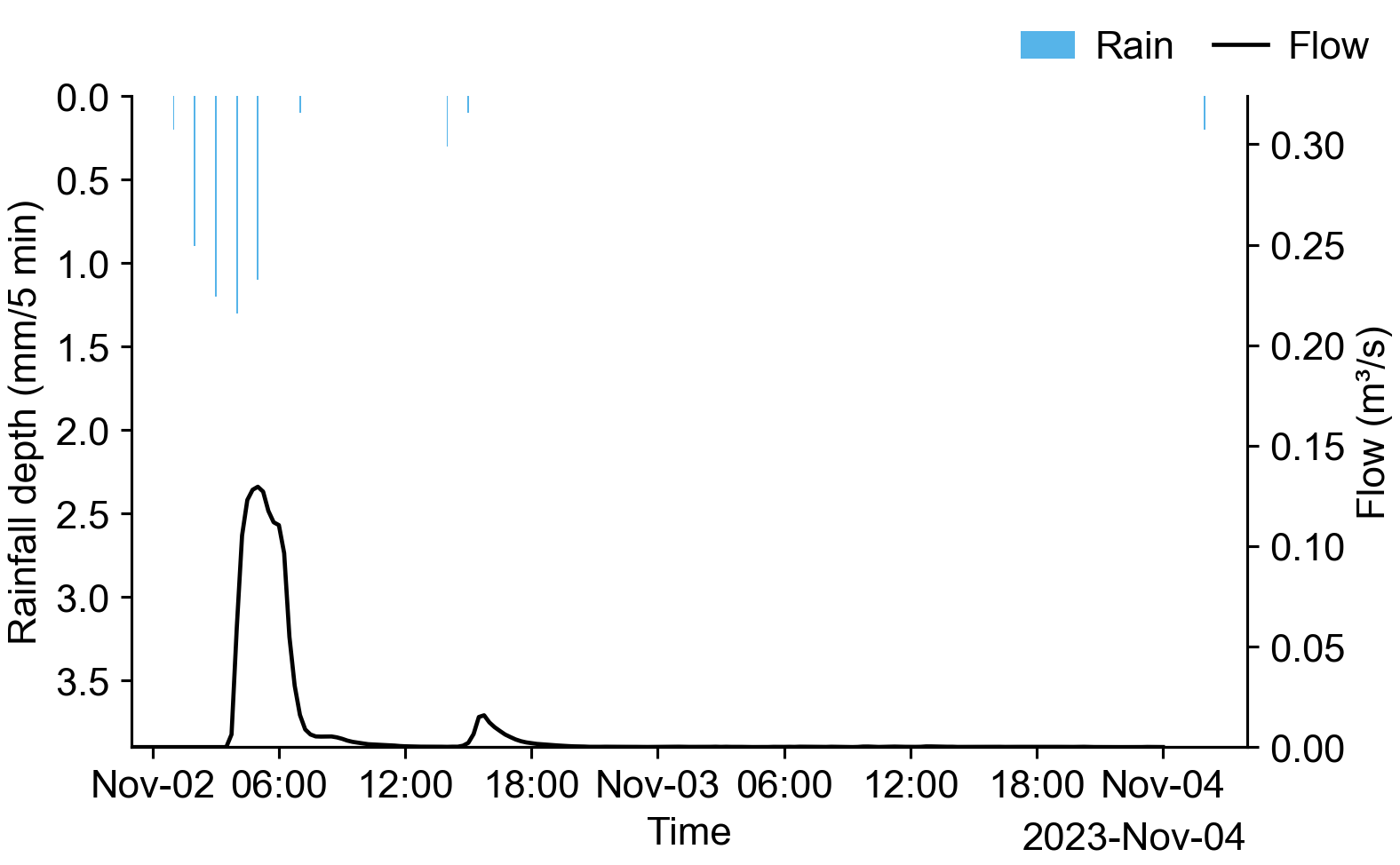
Uncalibrated model, 1–4 November 2023
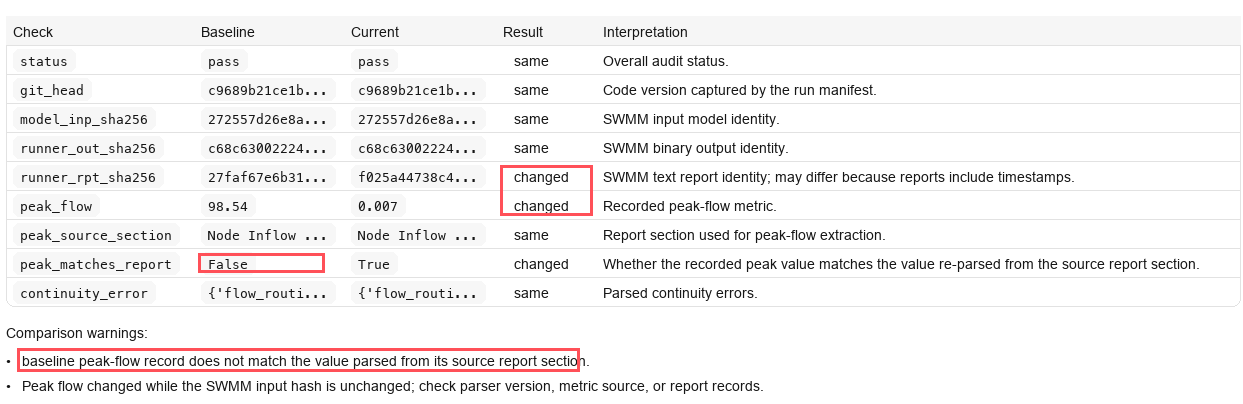
Metric provenance check
The short introduction explains the modelling loop. The repository contains the runtime, 19 skills, 11 MCP servers, 58 typed tools, tests, benchmarks, and audit contracts.
Zhang, Z. & Valeo, C. · Volume 1, Issue 1, Article 5
Read the paper ↗The modelling problem and the human-control boundary.
Vision → 02Runtime, skills, evidence contracts, memory, calibration, and climate scenarios.
Features → 03Benchmarks, research previews, and explicit evidence limits.
Validation → 04One-line installer, PyPI, Docker, provider routes, and portable skills.
Install →